
Posture Variability Over Perfection – A Practical Guide for Desk Workers
A simple, clinically reviewed guide for office and home workers
Why Posture Variability Matters
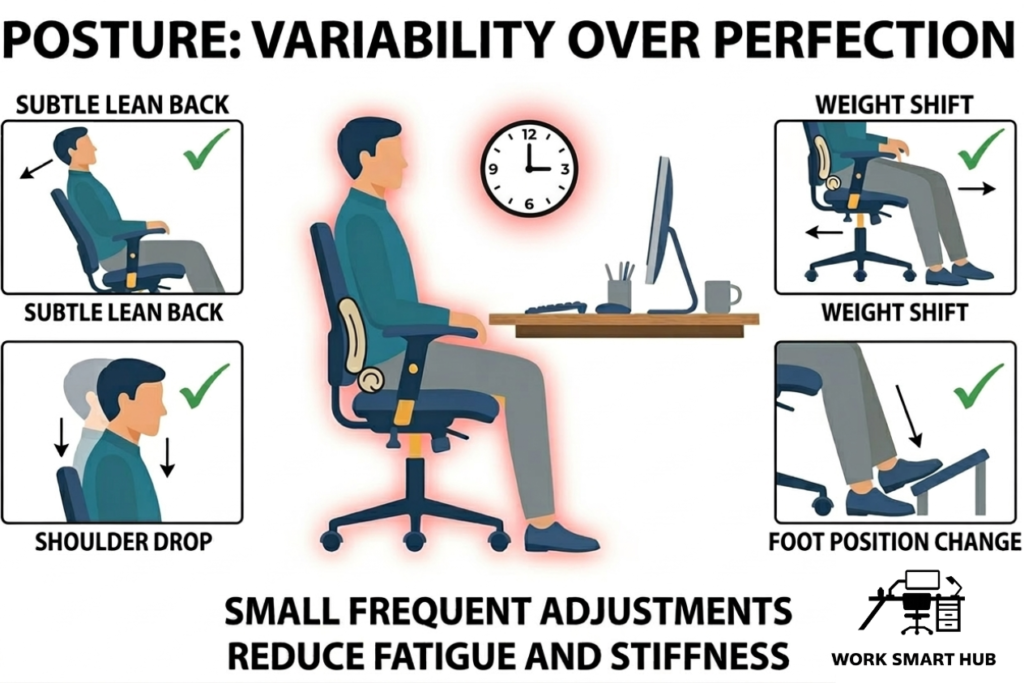
Posture is often misunderstood as a single “correct” position you should hold all day. In reality, the human body is built for movement, not stillness. Even an ideal sitting posture becomes uncomfortable when held for long periods because muscles fatigue, circulation decreases, and spinal loading increases.
Research supports this. Studies on dynamic sitting and posture variability suggest that regularly shifting posture during seated work may reduce discomfort and muscle fatigue compared with maintaining a rigid upright position (O’Sullivan et al., 2012; Swinton et al., 2017).
People who vary their posture throughout the day often report less discomfort, even when their posture isn’t perfectly upright.
A healthy posture is one that is relaxed, supported, comfortable, and frequently adjusted.
This article explains how to build dynamic, sustainable posture habits into your workday.
Who This Guide Is For
This guide is designed for:
- Desk workers who sit for long periods
- People who try to “sit up straight” but still feel discomfort
- Anyone experiencing neck, shoulder, or lower-back stiffness during computer work
- Workers who have already optimised their workstation but still feel fatigued
- Individuals confused by conflicting posture advice online
If you’ve ever wondered why “perfect posture” still leads to pain, this guide will help you understand what your body actually needs.
Quick Posture Resets – Under 30 Seconds
These small adjustments help break up static posture without interrupting your workflow:
- Lean back into your chair’s backrest
- Shift your weight slightly left or right
- Adjust your pelvis with small anterior/posterior tilts
- Relax your shoulders and let them drop
- Re-center your head over your torso
- Change your foot position (floor, footrest, staggered stance)
- Recline briefly to unload the spine
These micro-adjustments reduce muscle fatigue and help maintain comfort between movement breaks.
Steps to Build Healthy, Dynamic Posture
1. Start with a Relaxed, Supported Base Posture
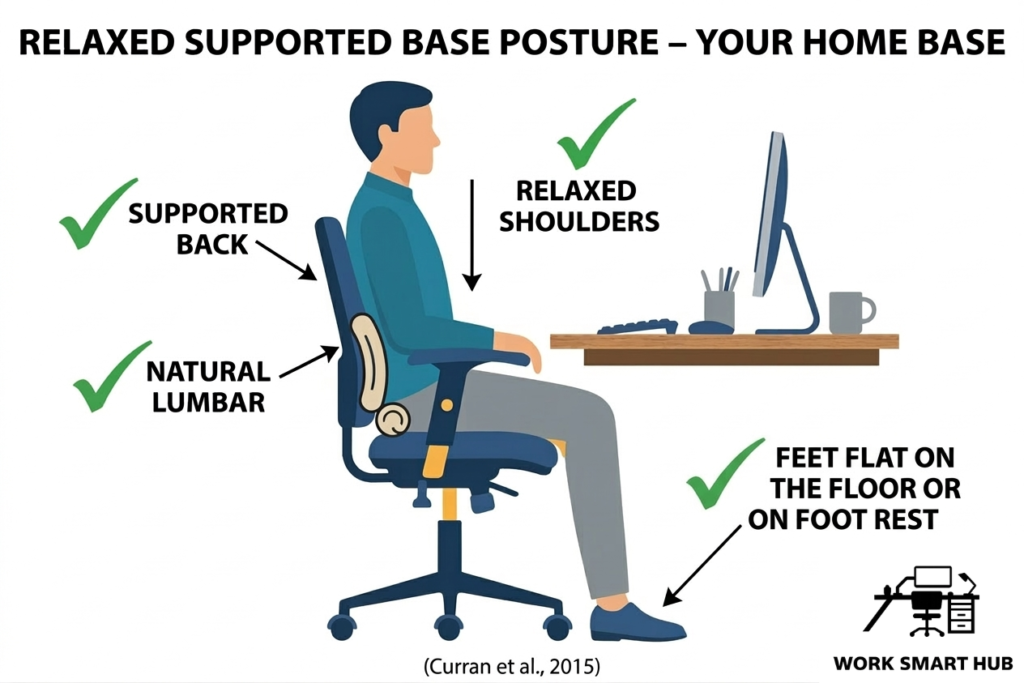
A sustainable posture is not rigid. It’s comfortable and supported by your chair.
Key features of a good base posture:
- Back supported by the backrest
- Natural lumbar curve (not exaggerated)
- Shoulders resting comfortably
- Elbows close to the body
- Feet supported on the floor or a footrest
This is your “home base” posture – but not the only one you should use. Research on seated posture biomechanics shows that supported sitting can reduce trunk muscle activity and perceived fatigue compared with unsupported or rigid upright sitting (Curran et al., 2015).
2. Change Posture Every 10–20 Minutes
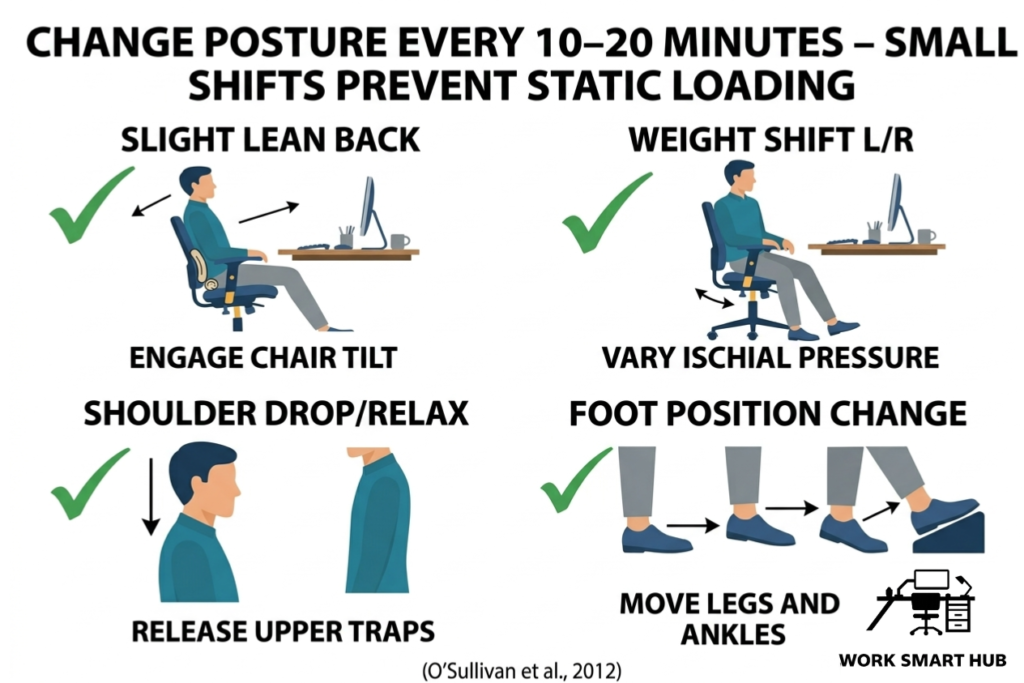
Small shifts prevent static loading. These don’t need to be dramatic – subtle adjustments are enough.
Examples:
- Lean back slightly
- Shift weight between hips
- Adjust arm support
- Change foot position
- Recline for a minute
Evidence from ergonomics research suggests that posture variability and dynamic sitting behaviors may reduce discomfort during prolonged seated tasks (O’Sullivan et al., 2012).
3. Use Your Chair Dynamically
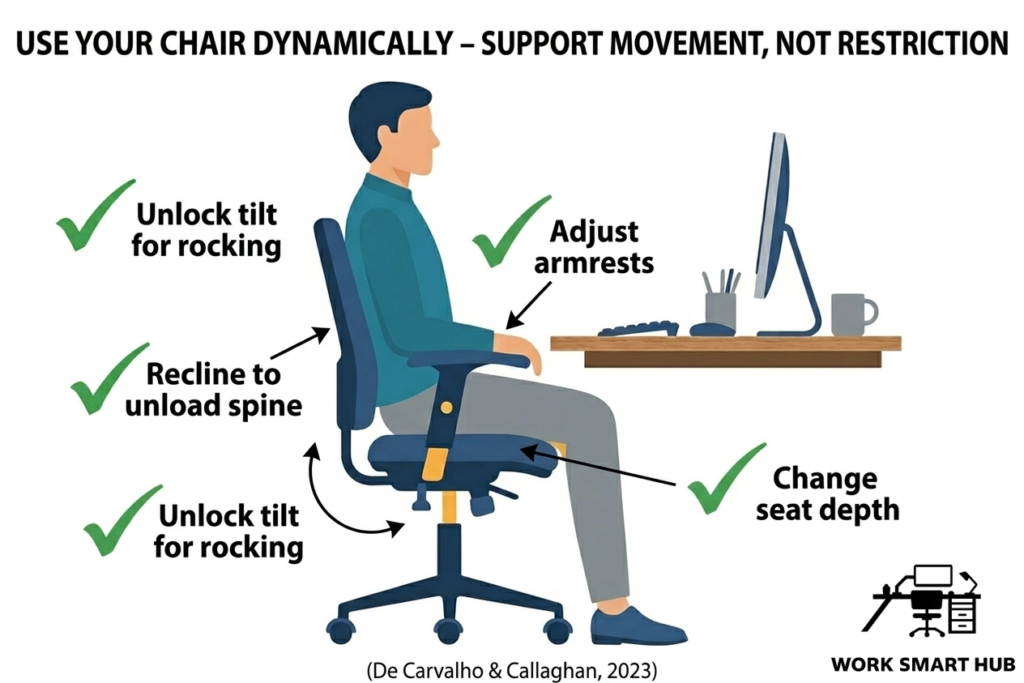
Your chair is designed to support movement, not restrict it.
Useful adjustments:
- Unlock the tilt to allow gentle rocking
- Recline to reduce spinal load
- Adjust armrests for different tasks
- Change seat depth or height if pressure builds
Dynamic seating designs have been shown to increase posture variability and may help reduce sustained spinal loading during seated work (De Carvalho & Callaghan, 2023).
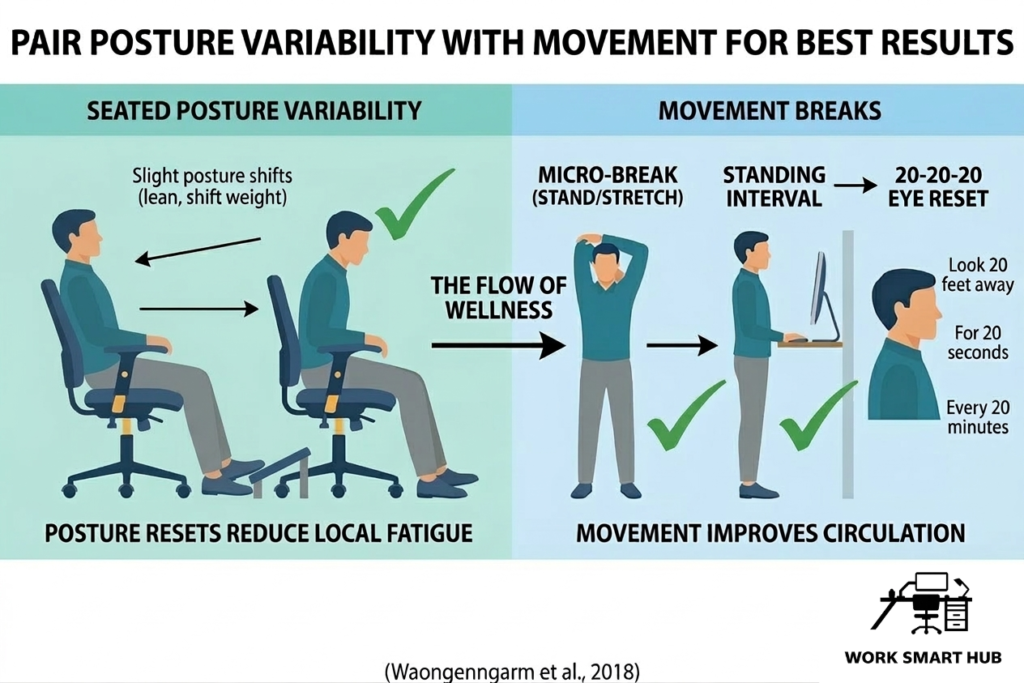
4. Pair Posture Changes with Movement
Posture variability works best when combined with movement breaks (see the Movement Breaks for Desk Workers guide).
Movement resets posture, and posture resets movement – both are important for reducing fatigue during desk work (Waongenngarm et al., 2018).
Common Myths About Posture
Myth 1: “There is one correct posture.”
There is no single ideal posture for everyone. People vary in spinal shape, muscle endurance, and comfort preferences.
Myth 2: “Sitting upright all day is best.”
Rigid upright sitting can increase trunk muscle activation and fatigue compared with supported or varied sitting postures (Curran et al., 2015).
Myth 3: “Slouching is always bad.”
Slouching becomes a problem mainly when it is sustained for long periods. Short periods of different sitting postures are part of normal posture variability.
Myth 4: “Good posture prevents all pain.”
Posture helps, but movement is equally important. Even ideal posture becomes uncomfortable when held too long.
Frequently Asked Questions
How often should I change posture?
Every 10–20 minutes. Even small posture adjustments can help reduce static loading.
Should I sit upright all the time?
No. Upright posture can be useful for focused tasks, but reclining periodically may reduce spinal loading.
Can posture variability replace movement breaks?
No. Posture variability reduces local muscle fatigue, but movement breaks improve circulation and reduce whole-body stiffness. Both are important for maintaining comfort during prolonged desk work.
Key Takeaways
- Good posture is dynamic, not fixed (O’Sullivan et al., 2012).
- A relaxed, supported posture is more sustainable than rigid upright sitting.
- Frequent posture changes reduce muscle fatigue and stiffness.
- Posture works best when paired with movement and micro-breaks.
- Small, regular adjustments make a meaningful difference in comfort.
References
- Curran, M., O’Sullivan, L., & O’Sullivan, P. (2015). Does using a chair backrest or reducing seated hip flexion influence trunk muscle activity and discomfort? A systematic review. Human Factors. https://doi.org/10.1177/0018720815591905
- De Carvalho, D. E., & Callaghan, J. P. (2023). Effect of office chair design features on lumbar spine posture, muscle activity and perceived pain during prolonged sitting. Ergonomics. https://doi.org/10.1080/00140139.2022.2152113
- O’Sullivan, K., O’Keeffe, M., O’Sullivan, L., & O’Sullivan, P. (2012). The effect of dynamic sitting on the prevention and management of low back pain and low back discomfort: A systematic review. Ergonomics. https://doi.org/10.1080/00140139.2012.676674
- Swinton, P. A., Cooper, K., & Hancock, E. (2017). Workplace interventions to improve sitting posture: A systematic review. Preventive Medicine. https://doi.org/10.1016/j.ypmed.2017.07.022
- Waongenngarm, P., Areerak, K., & Janwantanakul, P. (2018). The effects of breaks on low back pain, discomfort, and work productivity in office workers: A systematic review. Applied Ergonomics, 68, 230–239. https://doi.org/10.1016/j.apergo.2017.12.003